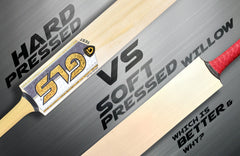
Hard-Pressed vs. Soft-Pressed Willow: Which Is Better & Why?
-
 Greenland Enterprises
- 2026-10-14
- 0 comments
 Greenland Enterprises

Choosing the right cricket bat is not just about its weight, shape, or willow quality. The pressing process also plays an important role in determining how a bat performs on the pitch. Hard-pressed and soft-pressed willow bats offer different playing characteristics, making it important to understand which option suits your playing style.
If you are looking for the best Kashmir Willow Bat, we at GLS Sports can help you understand the difference between these two pressing methods and can help you make a smarter buying decision.
Hard-Pressed Willow: Built for Durability -
Hard-pressed willow undergoes greater surface compression, helping the blade handle repeated ball impacts. This can be useful for players who practise regularly, face hard cricket balls, or need a bat for frequent matches.
Key benefits:
-
Better resistance to surface indentations in many cases.
-
Suitable for regular practice and match use.
-
Can provide consistent performance when manufactured correctly.
However, excessive pressing may reduce the wood's responsiveness. The right balance is essential to maintain both durability and rebound.
Soft-Pressed Willow: Focused on Feel and Response -
Soft-pressed willow undergoes comparatively less compression. Depending on the willow quality and manufacturing process, it may offer a more responsive feel when striking the ball.
Key benefits:
-
May provide a softer feel on impact.
-
Can suit players who prioritise bat response and shot timing.
-
Offers an alternative for players who prefer less heavily compressed blades.
The trade-off is that a softer surface may be more susceptible to indentations. Proper knocking-in, suitable ball selection, and regular maintenance remain important.
Key Differences between Hard-Pressed vs. Soft-Pressed Willow:
|
Feature |
Hard-Pressed Willow |
Soft-Pressed Willow |
|
Surface compression |
Higher compression |
Lower compression |
|
Durability |
Generally offers better surface resistance to repeated impacts |
May show surface indentations sooner |
|
Initial response |
Can feel firmer on impact |
Can feel softer on impact |
|
Performance |
May require more knocking-in, depending on manufacture |
May feel responsive earlier, but still needs proper preparation |
|
Best suited for |
Players prioritising durability |
Players who prefer a softer feel and responsive blade |
Which Kashmir Willow Bat Should You Choose?
This all boils down to your playstyle and individual choice.
-
If you play often: Think about a good hard-pressed bat.
-
For timing and stroke: Look into the feel and response of soft-pressed and hard-pressed bats.
-
Beginners: Pay attention to the weight of the bat, balance, and proper handle instead of the pressing itself.
-
Club players: Judge the quality of willow, consistency of pressing, the blade shape, and the way it performs with the ball you usually play against.
Choosing a Kashmir Willow Bat thinks that a good blade with proper pressing could be more useful than pressing level only choice of bat.
Conclusion:
Hard-pressed willow should definitely be considered in situations where longevity is the issue, whereas soft-pressed willow may be considered by those who like a more responsive bat. Neither will suit all players.
GLS Sports offers you a range of cricket bats made from top-quality willow, which you can consider based on their bat construction, pickup, willow used, and playing requirements. The Best Kashmir Willow Bat is thus one that offers all this in one bat.